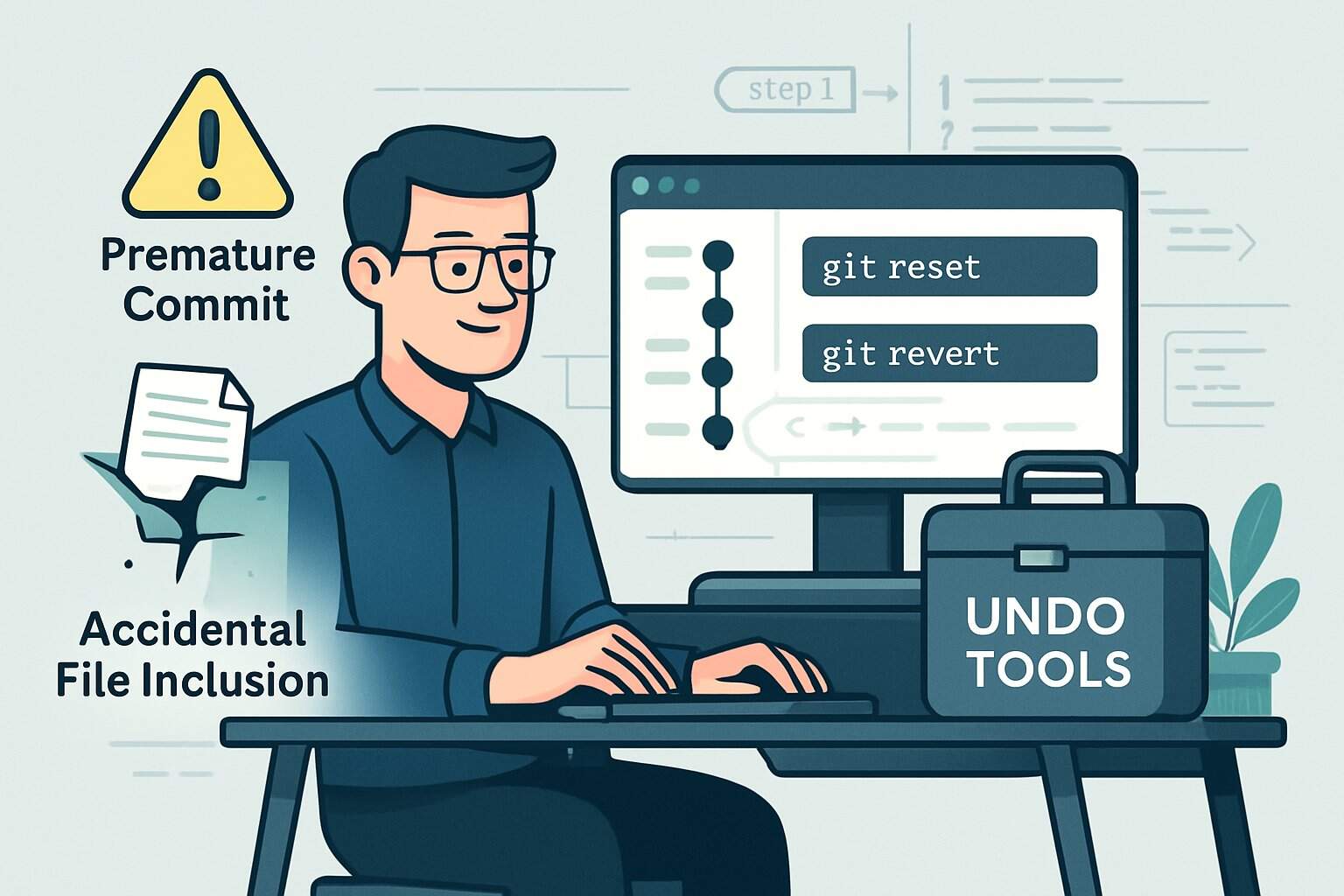
How to Uncommit the Last Git Commit in Malaysia
Introduction
You committed too soon, the message is off, or a file slipped in by mistake. It happens to everyone. The good news is that Git gives you precise tools to undo the latest commit without losing your work—or to erase it completely when that’s the right call. In this step-by-step review of your options for 2025, you will learn how to choose the safest and fastest method for your situation so you save time and keep your history accurate. If you arrived here searching how to uncommit last commit, this guide walks you through the scenarios, explains the features behind each command, and shows you how to recover cleanly when something goes sideways.
What Are Commits in Git?

A commit is a snapshot of your repository at a point in time. It captures the state of tracked files and ties them to a unique hash so you can revisit, compare, or roll back history. Commits are arranged in a directed graph, usually a simple chain on a branch, and Git moves a pointer named HEAD to track where you currently are. When you “uncommit,” you are either changing where HEAD points, altering the staging area (the index), rewriting the last commit, or creating a new commit that undoes previous changes.
Understanding these moving parts—HEAD, the index, and the working tree—helps you pick the right approach. The index is your staging area for the next commit, while the working tree is your actual files on disk. Different undo methods target one or more of these layers, which is why the outcome can vary from “everything preserved” to “gone from disk.” This foundational knowledge ensures that when you need to undo last commit actions, you do so with precision and minimal risk to your project’s integrity.
How to Uncommit the Last Commit in Git
There is no single best command for every case. Instead, think in terms of what you want to keep: the commit, the staging, the file changes, or none of the above. Below are common scenarios and the precise commands that match them, followed by a method-by-method review that explains what each tool does under the hood. Read each scenario first so you can choose the most accurate approach on the first try. By aligning your goals with the right Git reset or revert strategy, you’ll enhance your workflow efficiency and maintain better control over your repository’s history.
Scenario 1: Undo the Commit but Keep Changes and Staging Intact
When you just want to take the last commit off the history but keep its changes staged as if you were about to recommit, use a soft reset. Run git reset --soft HEAD~1 to move HEAD back by one commit while preserving the index. Your working files and staging remain untouched, so you can immediately run git commit again, perhaps with an updated message or after adding one more file.
This scenario is ideal when your content is correct but the commit itself was premature or mis-labeled. Because nothing leaves the index, you do not risk losing the edits you just made. It is also fast—you effectively rewind the pointer and are ready to recommit in seconds.
Keep in mind that this method rewrites local history. If you have already pushed, you should consider a revert instead, or coordinate with teammates before force pushing. Overall, soft reset is a go-to for quick adjustments without disrupting your staged work.
Scenario 2: Undo the Commit and Unstage Changes but Keep Files Intact
If you want to back out the last commit and review your changes before staging again, a mixed reset is the default. Run git reset HEAD~1 or explicitly git reset --mixed HEAD~1. This moves HEAD back and clears the index, leaving your files in the working directory. Your changes are safe, but now nothing is staged, so you can choose exactly what to include next.
This approach is perfect when you committed too much and want to split the work into smaller commits. After resetting, use git add -p to stage hunks interactively and craft a more meaningful series. You preserve accuracy by staging only the pieces that belong together.
Because the working tree still contains your edits, this method is non-destructive and friendly for iterative refinements. As with other resets, avoid using it on public history unless you plan to force push and your team agrees. This flexibility makes mixed reset essential for refining commit granularity in your Git practices.
Scenario 3: Undo Everything, Discard Changes, and Reset to Previous Commit
Sometimes you want a clean slate and to drop both the last commit and the changes it introduced. Use a hard reset with git reset --hard HEAD~1. This moves HEAD back, clears the index, and overwrites the working tree to match the previous commit. It is the nuclear option for when an experiment went wrong and you simply want to return to stable ground.
Because it modifies files on disk, this is destructive and should be used with care. If you ran it by accident, you can often recover with reflog, but prevention is better than cure. Double-check the commit you are resetting to, and consider whether a revert would be safer if your work is shared.
Hard reset is fast and definitive, making it appropriate for local throwaway branches and quick cleanups. Always pause and confirm that nothing valuable is only present in the commit you are discarding. By exercising caution, you can leverage this powerful tool without unnecessary data loss in your Git operations.
Scenario 4: Undo a Commit Already Pushed to a Remote Branch
When a commit is public, the safest option is to create a new commit that undoes it. Use git revert <hash> or, to revert the latest, git revert HEAD. This preserves history and is friendly to collaborators because it avoids rewriting commits that others may already have pulled. After reverting, push the new commit and carry on.
If you must rewrite history—for example, to remove sensitive data—you can still use reset locally and then force push with git push --force-with-lease. The “with-lease” flag adds a safety check so you do not clobber someone else’s work. Coordinate with your team and ensure protected branches allow this operation before proceeding.
A general rule of thumb is to prefer revert for shared branches and reserve reset for local fixes. That way, you maintain accuracy in the communal log without surprising your teammates. This approach not only safeguards collaboration but also aligns with best practices for managing remote repositories.
Scenario 5: Undo Multiple Commits and Step Back Further
To step back several commits, you can use reset with a count. For example, git reset --soft HEAD~3 keeps all changes staged but moves history back by three commits. Likewise, git reset --mixed HEAD~3 unstages everything while preserving your files, and git reset --hard HEAD~3 discards those three commits and their changes entirely.
If the commits are already pushed or you want a safer route, revert can handle ranges. You can run git revert A..B to create a series of reverse commits for everything after A up to B, or use git revert --no-commit A..B to stage all reversions together and finalize with one commit. This keeps shared history intact and clearly documents the rollback.
Always review your log with git log --oneline to confirm the range. A quick check helps you avoid reverting or resetting more than intended. Mastering these techniques allows you to handle bulk undos confidently in complex project histories.
Method 1: Using Git Reset
Git reset is the precision tool for moving HEAD and optionally altering the index and working tree. It comes in three modes—soft, mixed, and hard—each designed for a different level of change. The command never deletes commits outright; it just changes what your branch points to. Those commits can still be found in reflog for a while, which is a useful safety net.
Thinking in terms of layers—HEAD, index, and working tree—makes the behavior intuitive and predictable, especially when you are aiming for accuracy in a time crunch. For instance, soft mode preserves staging for quick recommits, mixed mode allows restaging flexibility, and hard mode provides a complete rollback. Before using reset, confirm the target commit with git log --oneline and, if needed, tag it for easy reference.
In graphical clients or IDE integrations, you will often find the same options under a “Reset current branch to here” menu, usually with clear warnings for hard resets. This accessibility extends the power of Git reset to users of all experience levels, promoting safer and more efficient version control practices.
Method 2: Using Git Revert
Git revert creates a new commit that inverses the changes introduced by a previous commit. It is the safest way to undo public history because it leaves the original commits in place, preserving the audit trail. To revert the last commit, run git revert HEAD, resolve any conflicts, and complete the process with a standard commit.
When you need to undo several commits, revert can be repeated for each one or used over a range. With git revert --no-commit A..B, Git applies the reverse changes to your working tree without committing, allowing you to review everything together before finalizing. This is especially helpful on shared branches where accuracy and traceability matter.
Revert is conflict-aware. If later commits depended on what you are undoing, you may need to resolve conflicts manually. Your Git client’s conflict resolution features can help, and the process remains well documented in history, ensuring transparency in collaborative environments.
Method 3: Using Git Commit –amend
Amend is perfect when the content is right but the commit needs refinement, such as fixing a message or adding a missed file. If you forgot to include a change, stage it and run git commit --amend to update the last commit with the new snapshot and message. If the content is fine and you only want to rewrite the message, use git commit --amend -m "New message".
Amend rewrites the last commit, changing its hash. That makes it excellent for local cleanup but risky on branches that others consume. If you have already pushed, prefer a new commit with the corrected message in the body or coordinate a force push with your team.
In many IDEs and Git GUIs, the “Amend last commit” checkbox appears in the commit panel. This feature streamlines the workflow so you can fix small issues without breaking your focus. Ultimately, amend enhances commit quality without extensive rework.
Method 4: Using Git Reflog
Reflog is your time machine. It records where HEAD and branch refs have been, allowing you to recover commits that appear lost after resets or amends. Run git reflog to view recent positions, find the commit you want, and then reset or create a new branch at that point with git switch -c rescue <hash> or git reset --hard <hash>.
This method is especially valuable when you used a hard reset too quickly and realized you needed something from the discarded commit. As long as the reflog entry is still around, you can resurrect it in seconds. It can also help you audit how your branch moved during complex rebases or interactive edits.
Because reflog is local, it does not track the remote’s view of history. Use it as a safety net on your machine, and remember to share fixes by pushing a restored branch or merging it back into your mainline. This tool underscores Git’s robustness in data recovery scenarios.
Tips and Best Practices to Avoid or Minimize Mistakes in Git
Preventing the need to undo commits is often faster than fixing them. With a few habits, you can commit with confidence and spend less time repairing history. The practices below emphasize accuracy, traceability, and a smoother day-to-day workflow, regardless of whether you use the command line or a Git-enabled editor. Incorporating these strategies will not only reduce errors but also optimize your overall Git usage for better SEO in technical documentation and tutorials.
Review Changes Before Committing
Make it routine to check your changes with git status and git diff, and use git diff --staged to inspect exactly what will go into the next commit. This quick review catches stray debug lines, secrets, or noisy formatting updates that deserve their own commit. If you prefer finer control, git add -p lets you stage hunks interactively so your history tells a clear story.
Many editors show an integrated diff and staged view, which reduces context switching and speeds up careful reviews. Treat these features like a safety check before you hit commit. A one-minute scan can save twenty minutes of undoing later.
When your team uses commit hooks or linters, run them locally or rely on your client’s pre-commit integration so you fix issues upfront. Automated checks help you stay consistent across machines and keep your main branch healthy. This proactive approach minimizes the frequency of needing to uncommit last commit actions.
Craft Meaningful Commit Messages
Write messages that explain the “why” and summarize the “what,” not just the file names. Following a structure such as Conventional Commits helps downstream tools generate changelogs and makes code review easier. A descriptive message reduces the need to revisit and amend later because the intent is already clear.
Use the verbose commit option git commit -v to include the diff in your editor when composing the message. Seeing the actual changes often nudges you toward a more accurate summary. If you do make a small mistake, amending before pushing is a clean way to fix it.
For larger changes, consider splitting the work into logical commits. Smaller, focused commits are easier to revert or cherry-pick, and you are less likely to reach for a risky hard reset when something goes wrong. This habit fosters clearer project histories and improves collaboration.
Harness the Power of Branches and Pull Requests
Work on feature branches rather than committing directly to your main line. This isolates experiments and gives you freedom to reset, amend, and reorder without affecting others. When you are ready, open a pull request so reviewers can examine the commits, test your changes, and catch issues early.
If you must rewrite a shared branch, push with --force-with-lease rather than a plain force. This option prevents you from overwriting work that was pushed by someone else while you were editing locally. Many platforms also support protected branches and required reviews, which reduce the chance of needing emergency undos on critical lines.
Whether you use a GUI or the command line, take advantage of features like stash, partial staging, and visual blame. These tools make it easier to keep your working tree tidy and your history accurate, which means fewer misfires and faster recovery when mistakes happen. Embracing branching strategies elevates your Git proficiency overall.
Conclusion
Undoing the last commit in Git is not one thing but several precise tools, each built for a different job. If you want to keep everything staged, use a soft reset; to unstage but keep files, choose mixed; to discard, hard reset; to undo public history safely, revert; and when you need rescue, lean on reflog. With these methods and the habits that support them, you can work faster, keep your history accurate, and recover confidently whenever a commit is not quite right.
Use the scenarios above to map your goal to the right action, then follow the method section for the exact command. Over time, you will choose the correct approach on reflex and spend more energy on building rather than fixing history. Remember, mastering how to uncommit last commit enhances your development efficiency in 2025 and beyond.
FAQs
Is git reset or git revert safer for shared branches?
git revert is safer for shared branches because it creates a new commit that undoes changes without rewriting history. Teammates who have already pulled your branch will not be disrupted. Use git reset primarily on local branches, or if you must rewrite, coordinate and use git push --force-with-lease.
How do I recover after an accidental hard reset?
Run git reflog to find the previous HEAD position, then restore it with git reset --hard <hash> or create a new branch at that point using git switch -c rescue <hash>. Reflog records recent moves of HEAD and branches, making recovery straightforward if you act before entries expire.
Can I change only the last commit message without touching files?
Yes. Use git commit --amend -m "Your new message". This rewrites the last commit with a new message while keeping the content intact. Avoid amending after pushing to shared branches unless you will force push and your team agrees.
What if the last commit was a merge?
Reverting a merge requires --mainline to indicate which parent to follow, for example git revert -m 1 <merge-hash>. Reset and reflog still work as usual on local branches, but for public history, revert with mainline is the safer, documented approach.
How can I avoid committing secrets or large files by accident?
Use a .gitignore to exclude large or generated files, enable pre-commit hooks that scan for secrets, and review diffs with git diff --staged before committing. If something slips through, remove it with tools like git filter-repo or the platform’s history rewrite utilities, and rotate any exposed credentials immediately.